
fumigar-plagas-sevilla.es · Tel. y WhatsApp 611 656 145 · Urgencias 24 h
Seen a big hornet in your garden or a nest in a wall, a shutter box or a tree, and think it is an Asian hornet? In Seville it is usually a different invasive species, the Oriental hornet. Here is how to tell them apart, and how we remove the nest safely.
- Write to us on WhatsApp in English
- Licensed company · ROESBA ES-41-S-03876-A
- Species confirmed before acting
- Urgent visits for nests near doors and pools
- Rated 4.8 on Google
Fumigar Plagas Sevilla is a licensed pest control company based in Sanlúcar la Mayor, in the Aljarafe, about 25 km west of Seville. Removing wasp and hornet nests is one of our most frequent jobs from spring to autumn. Before we act we always confirm the species, because each one nests in a different place and needs a different method.
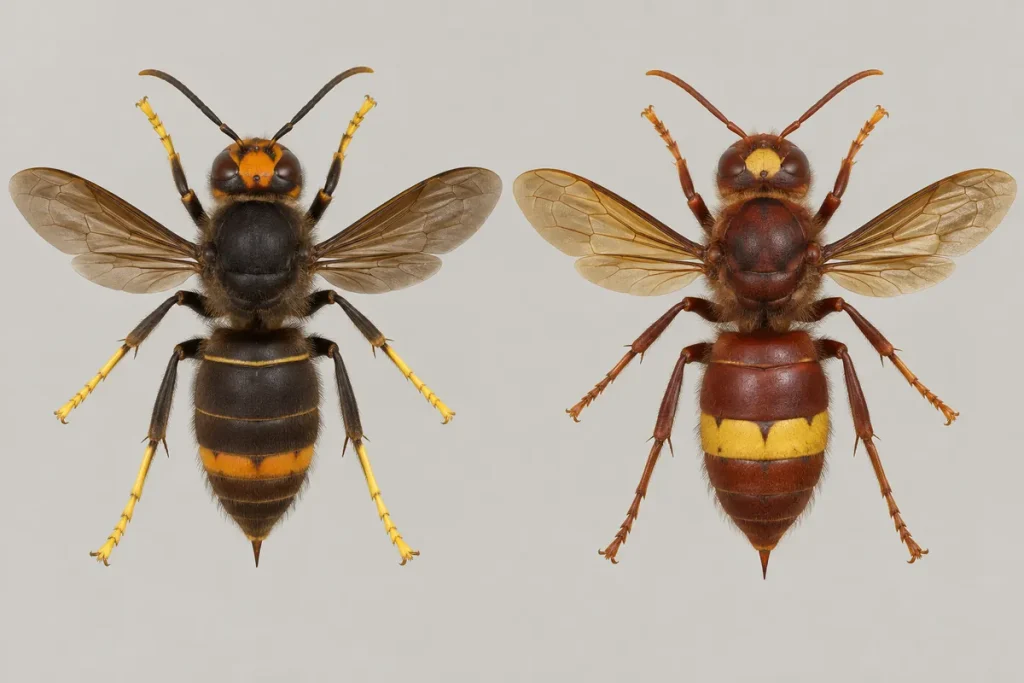
Is there Asian hornet in Seville?
The Asian hornet (Vespa velutina) arrived in France around 2004 and in Spain in 2010, and it has spread widely across the north of the country. In Andalusia, official sources only record isolated sightings, in Cádiz, Huelva and Málaga. A 2025 study by the Doñana Biological Station (EBD-CSIC) recorded new hornet sightings in the province of Seville, but of the Oriental hornet (Vespa orientalis), not of the Asian hornet.
So if you see a large hornet in Seville or the Aljarafe, the most likely species is the Oriental hornet. It is also invasive in Spain, and since 2025 it has been listed by name in the Spanish catalogue of invasive alien species. The Asian hornet is still moving south, so it is worth knowing how to recognise it.
Asian hornet or Oriental hornet: how to tell them apart
| Asian hornet | Oriental hornet | European hornet | |
|---|---|---|---|
| Scientific name | Vespa velutina | Vespa orientalis | Vespa crabro |
| Overall colour | Very dark, almost black | Reddish-brown | Reddish-brown thorax, mostly yellow abdomen |
| Abdomen | Dark, with a single orange band | Reddish-brown with one broad yellow band | Yellow with dark markings |
| Legs | Dark with yellow tips | Reddish-brown | Reddish-brown |
| Where it nests | Mainly high in tall trees | Cavities: ground, walls, shutter boxes, roof spaces | Hollow trunks and sheltered spaces |
| Status in Spain | Invasive | Invasive | Native |
Quick rule: if the hornet is reddish-brown with a bright yellow band and flies in and out of a hole in the ground, a wall or a shutter box, it is not an Asian hornet. It is most likely an Oriental hornet.
What to do if you find a hornet nest
- Keep your distanceStay at least 5 metres away. Do not try to knock it down, burn it, soak it or spray it with household insecticide.
- Keep children and pets awayWarn your neighbours if the nest is in a shared area or near a pool.
- Take a photo from a distanceUse the zoom. With a photo we can usually tell the species.
- Call a licensed companyIf the nest is next to a door, a terrace, a pool or a school, it is urgent.
How we remove hornet nests
- Confirm the speciesAsian hornet, Oriental hornet, European hornet or wasp: the location, the access and the method all change.
- Locate the nest and secure the areaWe follow the workers back to the nest, check its height and size and set a safety perimeter.
- Choose the momentEarly morning or evening, when almost all the hornets are inside the nest.
- Protective equipmentOur technicians wear hornet-specific protective suits, thicker than ordinary beekeeping suits.
- Removal and disposalDepending on the case we bag and remove the nest or treat it through the entrance with an authorised product, using a pole for high nests. The nest is not left on site, and you receive a service certificate.
Areas we cover
We remove hornet and wasp nests across Seville and the Aljarafe: Tomares, Mairena del Aljarafe, Bormujos, Gines, Espartinas, Castilleja de la Cuesta, Sanlúcar la Mayor, Umbrete, Benacazón, Salteras and more, and we travel further across the provinces of Seville, Huelva and Cádiz.
Prefer Spanish? Read our detailed guide in Spanish: Avispa asiática (Vespa velutina), or our page on the avispón oriental. For other pests, see our pest control in Seville page.
Asian hornet in Seville: frequently asked questions
Is the Asian hornet dangerous to people?
A single hornet away from its nest rarely attacks. The danger is the nest: if it is disturbed, the colony defends it and can cause multiple stings, which are more dangerous for people with allergies.
Is the Oriental hornet dangerous?
Like other hornets, it defends its nest and its sting is painful. Because it nests in cavities in walls, the ground and shutter boxes, it often ends up very close to people, which is why its nests should be removed by professionals.
Can I remove the nest myself?
It is not recommended. Without hornet-specific protective equipment, disturbing the nest can lead to multiple stings, and many nests are high up or inside walls.
Do hornet traps work?
Not very well. They are not selective, they also catch other insects and they do not eliminate the nest.
How quickly can you come?
For nests next to doors, terraces, pools or schools we organise urgent visits. Send us a photo on WhatsApp so we can plan the job.
Sources: CSIC Andalusia, EBD-CSIC study on invasive hornets in Andalusia (27/01/2026); Robla J. et al., Biological Invasions, 2025; Junta de Andalucía, invasive alien species updates; BOE, Orden TED/452/2025.
Hornet nest at home?
Send us a photo on WhatsApp and we will tell you which species it is.
Fumigar Plagas Sevilla · Calle Cardenal Spínola 6, 41800 Sanlúcar la Mayor (Seville) · ROESBA ES-41-S-03876-A
fumigar-plagas-sevilla.es · Tel. y WhatsApp 611 656 145 · Urgencias 24 h