
fumigar-plagas-sevilla.es · Tel. y WhatsApp 611 656 145 · Urgencias 24 h
Found mud tubes on a wall, a skirting board that sounds hollow or a swarm of winged insects by the window? Termite control in Seville starts with a proper inspection: we find where the colony is, how far the damage goes and which treatment your property really needs.
- Write to us on WhatsApp in English
- Licensed company · ROESBA 1438-AND-850
- Non-invasive inspection equipment
- Written quote, no obligation
- Rated 4.8 on Google
Important warning
The greatest danger of termites: a network of galleries inside your walls
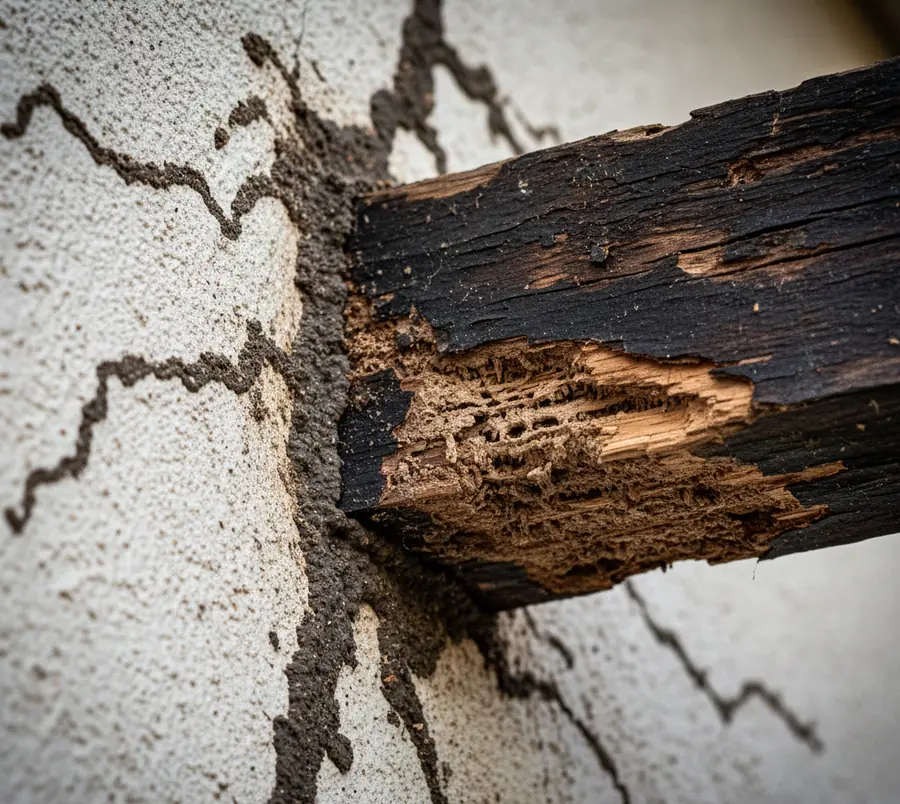
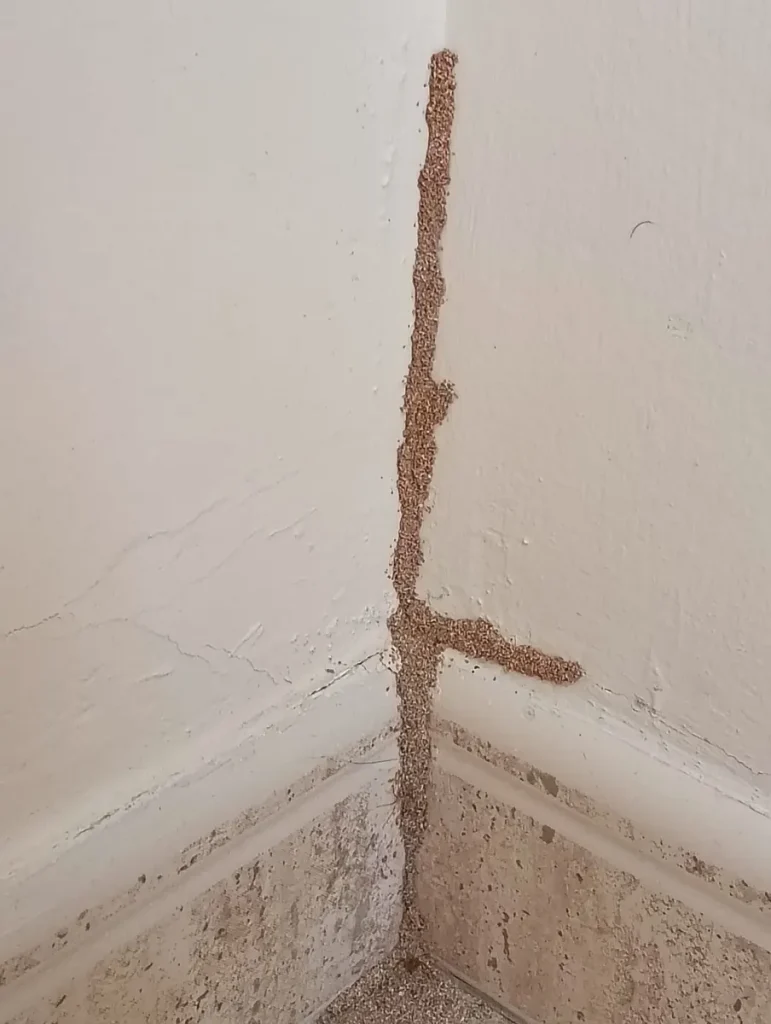
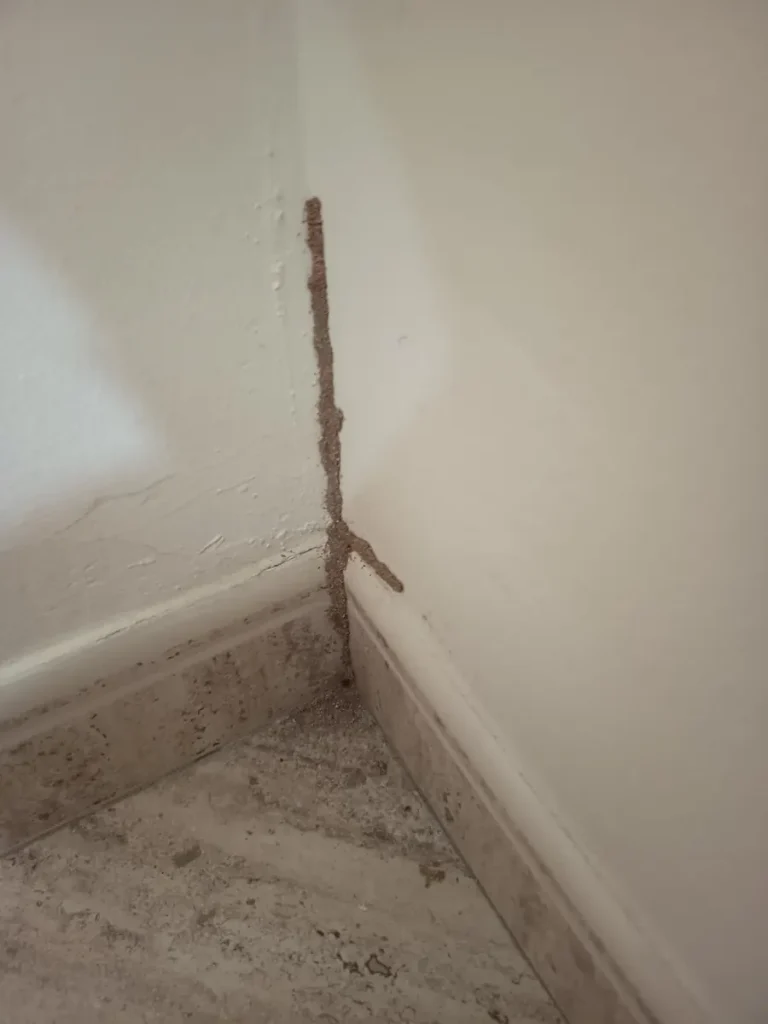
Subterranean termites build a network of galleries inside the walls of your home. Coming up from the soil, they use existing joints, cracks and gaps to build sheltered passages that branch out inside the walls like a hidden spider’s web. When a worker finds a source of cellulose, it leaves a pheromone trail that leads the rest of the colony to the food. The mud tubes you can see on a wall are only the visible stretch of part of that network, and the termites keep building and extending it 24 hours a day, 7 days a week.
This is how they erode and hollow out the wall from within: the lime-and-sand mortar, the cement, the gypsum plaster and the plaster mouldings. The wall gradually loses the structural strength that holds up the house, with nothing showing from outside. This structural termite damage is the most serious of all.
On top of that they attack the timber: beams, joists, floor structures and frames. Over the years cracks appear, plaster comes away, walls and ceilings start to give and, if nothing is done, parts of the house can collapse. The damage does not stop on its own; it gets worse year after year. The sooner you act, the less wall and timber will need repairing.
Signs that mean you should call now:
- Mud tubes on walls or skirting boards.
- New cracks in walls or ceilings.
- Plaster coming away, or a wall that sounds hollow when tapped.
- Timber that sounds hollow, or doors and frames that give way.
- Swarms of winged termites in spring.
- Dust or soil in the joints.
Seen any of these signs? Call now: we treat it as a priority.
The technical inspection has a cost, which is deducted from the quote if you go ahead with the treatment.
Fumigar Plagas Sevilla is a licensed pest control company based in Sanlúcar la Mayor, in the Aljarafe, about 25 km west of Seville. Termites are one of the most common problems we treat: the warm climate, the clay soils of the Aljarafe and the many old houses with timber beams, doors and floors make Seville a high-risk area. After the inspection you get a written report of what we find.
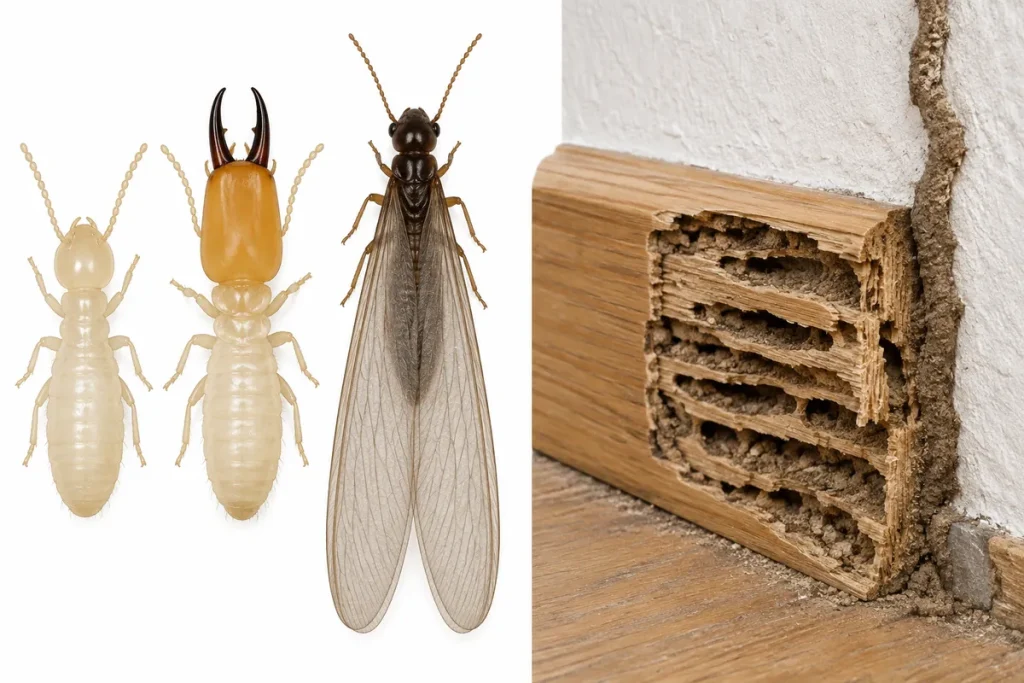
Which termites do we find in Seville?
Two kinds of termite cause almost all the damage in homes around Seville. They live differently, so they are treated differently.
| Termite | What you see | Where it lives | Treatment |
|---|---|---|---|
| Subterranean termite (Reticulitermes) | Mud tubes on walls and skirting boards, wood that sounds hollow, winged swarmers in spring. | The colony lives in the soil and comes up into the building through walls, floors and cracks. | Bait systems to eliminate the colony and, where needed, a chemical barrier in the soil or walls. |
| Drywood termite (Kalotermes flavicollis) | Small piles of hard, grain-like droppings under furniture, frames or beams. | The whole colony lives inside a single piece of dry wood. | Treatment of the affected piece by injection. |
Woodworm beetles (common furniture beetle, house longhorn beetle, powderpost beetle) also damage timber in Seville. They leave round or oval exit holes and fine dust, which termites do not. Getting the identification right is the first step, because a woodworm treatment will not stop termites, and vice versa.
Signs of termites in your home
Mud tubes
Thin tunnels of earth running up walls, foundations or skirting boards. Subterranean termites build them to travel without drying out.
Hollow-sounding wood
Door frames, skirting boards or beams that sound hollow when tapped, or that a screwdriver goes into easily.
Swarmers and wings
Winged termites, or piles of their wings, near windows and lights, usually on warm days in spring.
Doors that stick
Frames that warp, paint that blisters and floors that sag can all be signs of hidden damage.
How we inspect: finding termites without breaking the wood
Termites often cannot be seen from outside, so we inspect with measuring equipment that locates moisture, activity and galleries behind walls, beams and frames, without drilling or opening up.
Pin moisture meter
Measures moisture inside timber and walls. Subterranean termites need damp conditions, so moisture points lead us to the source.
On-site thermal imaging
A thermal camera shows temperature differences in walls, floors and ceilings that reveal damp areas, nests and hidden activity.
Thermometer
Confirms the thermal readings so a simple damp patch is not mistaken for a termite nest.
Stethoscope
We listen for the sound of termites moving and chewing inside the wood to confirm the colony is active.
Endoscope
A thin camera goes in through a small hole to see the galleries and chambers inside, without taking anything apart.
Supervised by a technical director. Every inspection is supervised by our technical director in environmental health, who specialises in wood-boring insects and timber pathology. The diagnosis (which pest it is, how far the damage goes and what treatment is needed) is based on measurements, not on a quick look.
Our termite treatment in 4 steps
- Inspection and written reportWe identify the species, map the affected areas and explain the options, with a written quote.
- Colony eliminationFor subterranean termites we install bait stations: workers carry the bait back to the nest and the colony is eliminated from within. Depending on the case we add a chemical barrier in the soil or walls.
- Treatment of affected woodInfested pieces are treated by injection with authorised products, and we tell you if any timber needs repair or replacement.
- MonitoringWe check the stations and the treated areas until there is no more activity. Bait systems take time to work: colony elimination is a process of months, not a single visit.
Areas we cover
We are based in Sanlúcar la Mayor and work every day across Seville and the Aljarafe: Tomares, Mairena del Aljarafe, Bormujos, Gines, Castilleja de la Cuesta, Espartinas, Umbrete, Benacazón, Olivares, Salteras, Camas and Coria del Río, among others. We also travel further across the provinces of Seville, Huelva and Cádiz.
Prefer Spanish? Read this service in Spanish: Eliminar termitas en Sevilla. For other pests, see our pest control in Seville page.
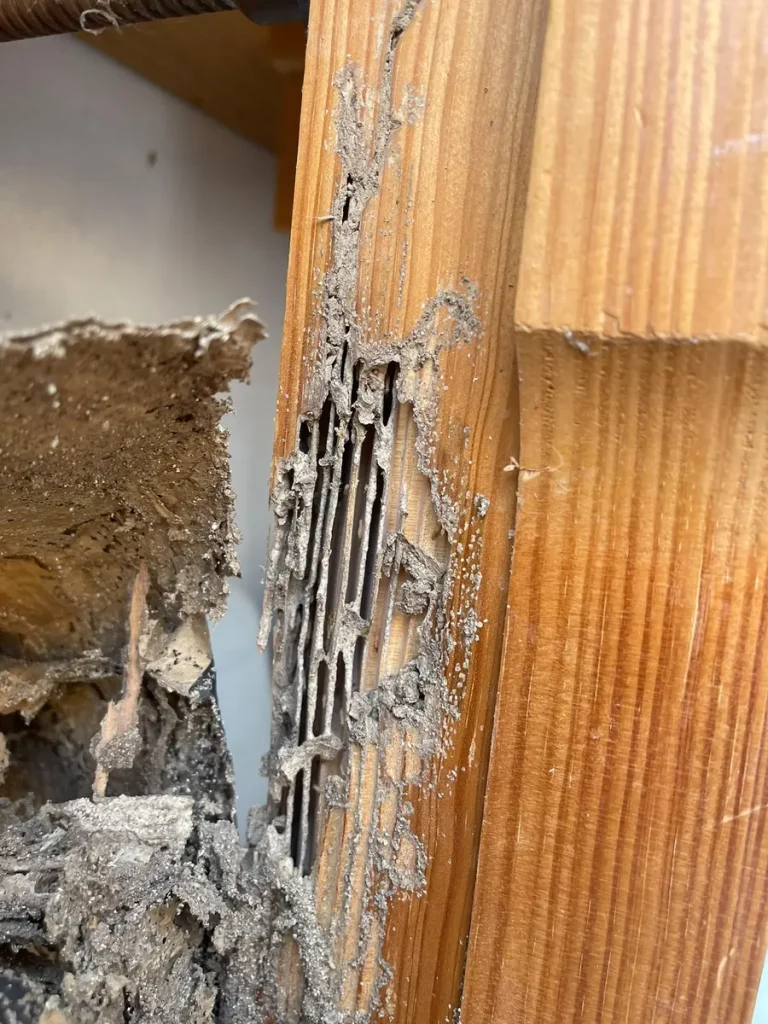
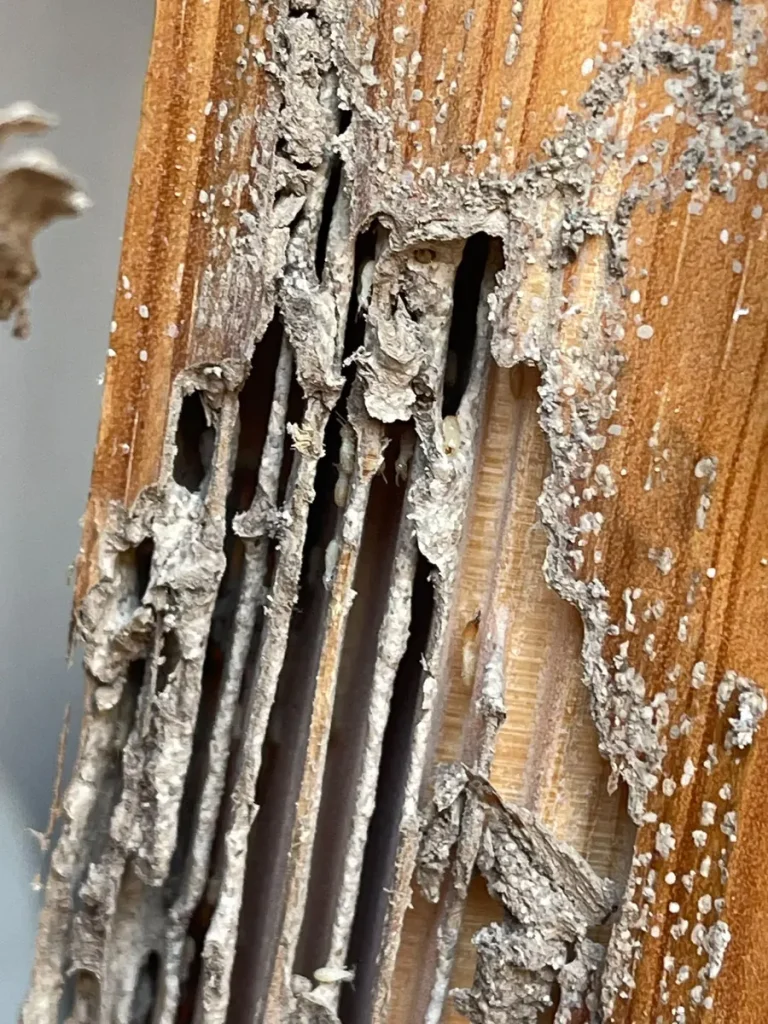
Photos from our termite jobs
Photos taken by our team during real inspections in Bormujos, Sanlúcar la Mayor and the Aljarafe.
Termite control in Seville: frequently asked questions
How do I know if I have termites or woodworm?
Termites leave no exit holes: the wood is eaten from inside and subterranean termites build mud tubes. Woodworm beetles leave small round or oval holes and fine dust. Send us a photo on WhatsApp and we will tell you what it looks like; the inspection confirms it.
Do I have to leave the house during the treatment?
Usually not. Bait systems and localised injections let you carry on living in the property. We give you clear safety instructions for each product, including for children and pets.
How long does it take to get rid of termites?
The installation is done in one visit, but eliminating a subterranean colony with baits takes months, and we monitor it until there is no activity. Drywood termites in a single piece of wood are usually solved faster.
How much does termite treatment cost?
It depends on the type of termite, the size of the property and how far the damage goes. After the inspection we give you a closed written quote, with no obligation.
Are you a licensed company?
Yes. Fumigar Plagas Sevilla is registered in the Official Register of Biocide Establishments and Services (ROESBA) of the Junta de Andalucía with number 1438-AND-850, and our technicians hold the professional biocide applicator qualification.
Think you have termites?
Call or send us photos on WhatsApp for a first opinion.
Fumigar Plagas Sevilla · Calle Cardenal Spínola 6, 41800 Sanlúcar la Mayor (Seville) · ROESBA 1438-AND-850
fumigar-plagas-sevilla.es · Tel. y WhatsApp 611 656 145 · Urgencias 24 h